


Planet Positive Event Methodology
A measurable framework for sustainable events
Planet Positive Event transforms event sustainability into structured, measurable, and reportable intelligence, helping organisers understand their environmental impact, improve operational sustainability, and create a long-term positive legacy.
Built specifically for the complexity of live events, PPE combines carbon footprint measurement, sustainability assessment, ESG reporting logic, and external validation into one integrated framework.
THE CHALLENGE
Sustainability in events can be difficult to measure
Events are temporary ecosystems involving venues, suppliers, logistics, catering, production teams, exhibitors, travel, accommodation, and thousands of attendees often across multiple locations and stakeholders.
The biggest challenges include:
- complex Scope 3 emissions,
- inconsistent supplier data,
- lack of event-specific ESG frameworks,
- disconnected carbon calculators,
- growing reporting expectations,
- sponsor and stakeholder pressure,
- federation sustainability requirements,
- and the absence of measurable long-term impact tracking.
Most tools only calculate carbon emissions.
Planet Positive Event was designed to go further.

THE PPE FRAMEWORK
Measuring events in three dimensions
Planet Positive Event measures sustainability across three interconnected layers:
FOUNDATION
Measuring the operational footprint of an event
The foundation layer measures the environmental impact generated across the full lifecycle of an event.
This includes:
- Scope 1 direct emissions,
- Scope 2 energy emissions,
- Scope 3 value-chain emissions,
- mobility,
- accommodation,
- production,
- catering,
- suppliers,
- exhibition infrastructure,
- waste,
- and energy consumption.
The methodology follows internationally recognized carbon accounting principles and event lifecycle assessment logic.
IMPACT
Measuring short-term sustainability performance
Beyond carbon measurement, PPE evaluates how an event performs operationally across environmental, social, and governance dimensions.
The framework incorporates sustainability indicators connected to:
- resource efficiency,
- accessibility,
- local impact,
- supplier responsibility,
- inclusion,
- mobility,
- circularity,
- stakeholder engagement,
- and event governance.
This layer is structured using Sustainable Development Goal (SDG) logic adapted specifically for events.
LEGACY
Measuring long-term ESG and regenerative contribution
Events create impacts that extend beyond the event itself.
PPE therefore evaluates long-term sustainability legacy through ESG-oriented assessment logic aligned with modern reporting expectations.
This includes:
- climate resilience,
- circular transformation,
- local economic contribution,
- community impact,
- supplier ecosystem development,
- governance maturity,
- education,
- innovation,
- and long-term regenerative initiatives.
The goal is not just to reduce harm, but to create measurable positive impact for destinations, communities, and industries.
From event data to sustainability intelligence
The PPE methodology transforms operational event data into actionable outputs that organizers can use internally and externally.
Carbon footprint measurement
Detailed event lifecycle emissions analysis.
Sustainability Assessment
Structured evaluation across environmental, social, and governance criteria.
SDG and ESG impact evaluation
Measurement of short-term and long-term sustainability contribution.
Sustainability roadmap
Automatically generated recommendations and improvement opportunities.
a
External assessment
Independent expert validation of the event assessment process.
Reporting
Structured reporting aligned with modern ESG and sustainability reporting principles.
Built on science. Improved through practice.
The PPE Methodology combines internationally recognized sustainability standards with real operational event experience.
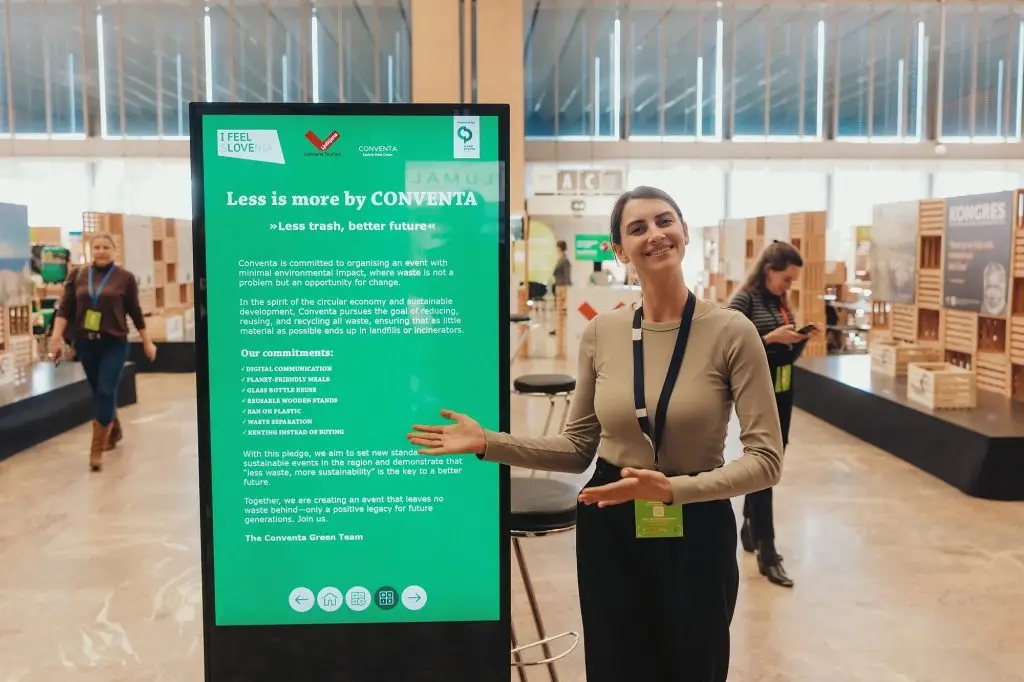
The framework is based on:
- GHG Protocol,
- ISO 20121,
- ISO 14064,
- GRI,
- ESRS,
- CSRD logic,
- and SDG frameworks.
To ensure credibility and consistency, assessments are supported by independent external experts from the fields of sustainability, ESG reporting, and event management.
The methodology is continuously improved through real-event testing, user feedback, benchmarking, and collaboration with industry professionals. Originally developed through practical implementation at Conventa, PPE continues to evolve alongside the sustainability transformation of the global events industry.