“There Is No 100% Sustainable Event”: Tsvetelina Trendafilova on Continuous Improvement and the Future of Event Sustainability
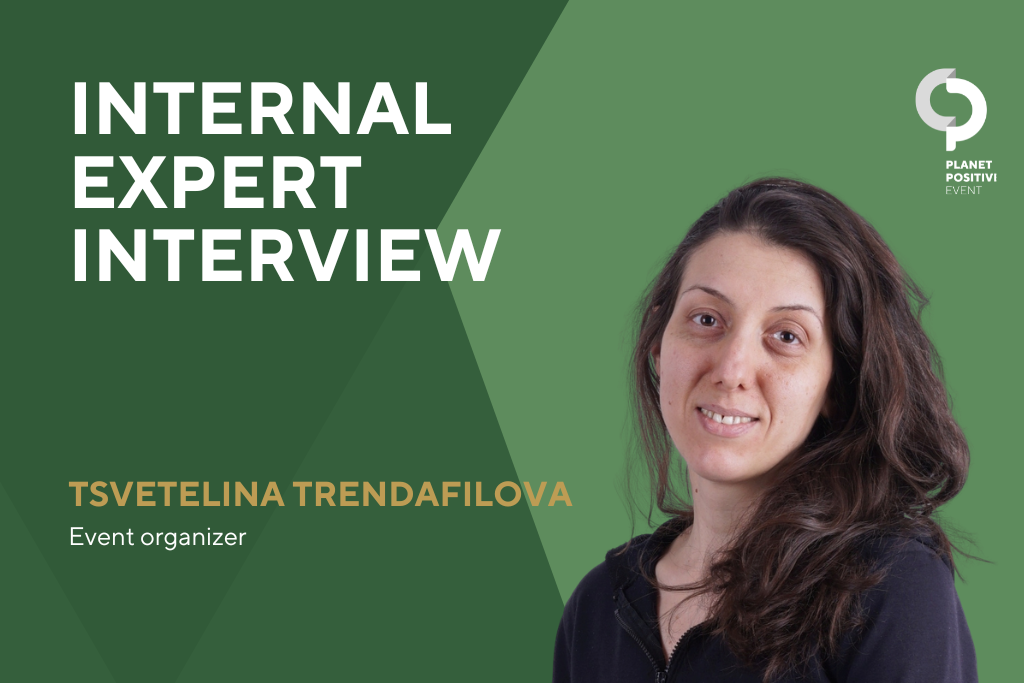
In this interview, Planet Positive Event assessor Tsvetelina Trendafilova shares her perspective on the evolving role of sustainability in the events industry. Drawing on years of experience in event organisation, she explores the importance of reliable data, ESG standards, and collaboration in reducing environmental impact. From tackling greenwashing to embracing new technologies, Tsvetelina highlights why creating more sustainable events is a continuous journey of learning, innovation, and improvement.
How did you first hear about Planet Positive Event?
I heard about Conventa and PPE in September 2024 during Gorazd’s participation in the Event Pro Forum in Sofia, Bulgaria. Then I followed him on LinkedIn and was impressed with his dedication to sustainability in the event sector.
What made you interested in becoming an internal expert?
Since 2008, I have been part of the team of the first private company in Bulgaria specializing in conference tourism, event management, and tour operating.
I have participated in organizing various corporate events in Bulgaria – from small events for 30 people up to conferences for 500+.
Over the years, after seeing how much unused resources were wasted in the landfill, I started researching with my colleagues to find options to reduce the negative impact after the events. I see how hard it was at the beginning in the 2000s, but I never stopped thinking and trying to improve it until now. I am glad to see the shift in understanding and importance not only of personal example, but also of brand engagement.
How do you understand the significance of the ESRS standards?
The importance of ESRS standards goes beyond compliance – they fundamentally change how companies measure success, requiring organizations to assess materiality from both financial and impact perspectives throughout their entire value chain. This represents an iterative process where sustainability reporting becomes as crucial as financial reporting for long-term business success.
How will the adoption of ESRS standards impact your work in the future?
Most of us (as event organizers) should know that there are no 100% sustainable events. We need to identify which sustainability topics are most significant for our events from both impact and risk perspectives. The impact will be huge: from investing in better data collection systems, and a structured approach to reporting ESRS standards to more engaging activities with our stakeholders, and investing in education.
What challenges do you anticipate event organizers facing when aligning with ESRS, and how can assessors assist?
As a first step, the event organizers need to define the company’s ESG aims and its focus. Otherwise, there will be no clear vision of the path to reach the ESG aims.
The MICE specialists would face the difficulty of gathering data from each provider, and the assessors could assist by coaching during this process with practical instructions and guidance.
How do you see Planet Positive Event helping organizers align with ESRS standards?
I was impressed by your 360-degree approach – with preventive management, carbon management, impact management, compliance management, and offset management.
The tool is a trusted system for measuring ESG efforts, a strong “weapon” against greenwashing.
Also, when we collect data from suppliers, stakeholders, and employees, we indirectly include them in the process of awareness and training on the topic, if they have not yet applied it in their companies. It will be easier to collect data if there are internal assessors on the data providers’ team, and the event organizers can speak the same language with them.
How do you envision the future of sustainability practices in the events industry, especially with tools like PPE?
Of course, AI is being successfully implemented (and will be used) in the sustainability process in so many different ways – from helping gather data for transportation and offering recommendations for low-carbon options, to helping venues track consumption in real-time and optimise energy use with immediate adjustments.
What key trends or innovations will shape sustainability in event planning over the next few years?
There is a trend of choosing eco-friendly venues – a great way to stimulate the best practices and help transform the market supply and demand in the MICE sector.
We can see the next-generation type of events – adoption of hybrid formats to cut travel, with a solar-powered stage, digitalization of materials (apps, smart badges) to reduce waste, with circular event design, and a more creative frame with gamification, etc.
What advice would you give to event organizers just beginning their sustainability journey?
First, accept your job as a mission. Remember how significant the impact of the events is when 3 to 5 million events are organized each day worldwide!
Then, try to choose partners and vendors that align with your sustainability concept. When it is not possible, try to communicate the importance of the process and the benefits for all stakeholders. Sometimes inaction can be caused by ignorance and insufficient information about the positive effects. So don’t give up.
There is no 100% sustainable event. However, never stop working to replace the event components with more sustainable alternatives.




Leave a Reply